
When to Refer; When to Act: Evolving Decision-Making in Aortic Disease Management

Earlier recognition, multidisciplinary evaluation, and individualized intervention strategies are reshaping outcomes for patients with complex aortic disease.
Aortic disease remains one of the most complex and time-sensitive conditions in cardiovascular medicine. Yet, despite advances in imaging, endovascular technology and surgical technique, delays in diagnosis and referral continue to drive morbidity and mortality.

Ashok Kumar Coimbatore Jeyakumar, M.D.
For clinicians managing patients with thoracic or abdominal aortic aneurysms, dissections or connective tissue disorders, decision-making is increasingly moving beyond simple size thresholds. Specialists at Baptist Health Heart & Vascular Care say earlier referral, multidisciplinary evaluation and individualized surveillance strategies are becoming just as important as the intervention itself.
“Aortic disease is a disease for a lifetime,” says Ashok Kumar Coimbatore Jeyakumar, M.D., known professionally as Dr. CJ, director of aortic disease with Baptist Health Heart & Vascular Care, and professor of cardiovascular sciences at FIU Herbert Wertheim College of Medicine. “It’s not a ‘one-and-done’ condition. These patients require lifelong surveillance, coordinated care and careful timing of intervention.”

Bradley Taylor, M.D.
Thinking of the Aorta as an Organ
Recent guideline updates increasingly frame the aorta not simply as a vessel, but as an organ system requiring longitudinal management across multiple specialties.
That shift reflects the growing complexity of patients being referred to tertiary aortic centers, including younger patients with connective tissue disorders, patients with chronic dissections, and individuals undergoing redo operations years after prior repair.
“When we talk about the aorta, we have to think about it in continuity — from the left ventricular outflow tract all the way to the femorals,” says Bradley Taylor, M.D., chief medical executive, Christine E. Lynn Heart & Vascular Institute; chief of cardiac surgery, Palm Beach Region, Baptist Health Heart & Vascular Care; and chief of quality and outcomes, Baptist Health Heart & Vascular Care. “That’s what we’re really managing.”
At Baptist Health, care planning involves a multidisciplinary aortic team that includes cardiac surgeons, vascular surgeons, interventional radiologists, cardiologists, imaging specialists, intensivists, anesthesiologists and geneticists. Complex cases are reviewed collaboratively through dedicated aortic conferences where advanced imaging, procedural planning and contingency strategies are discussed in detail.
“If you ever have a question about referring, refer,” Dr. Taylor says. “We want to co-manage these patients with the physicians already taking care of them.”
Moving Beyond Diameter Alone
While traditional intervention thresholds remain important, physicians say contemporary aortic care increasingly incorporates additional risk variables beyond aneurysm size alone.
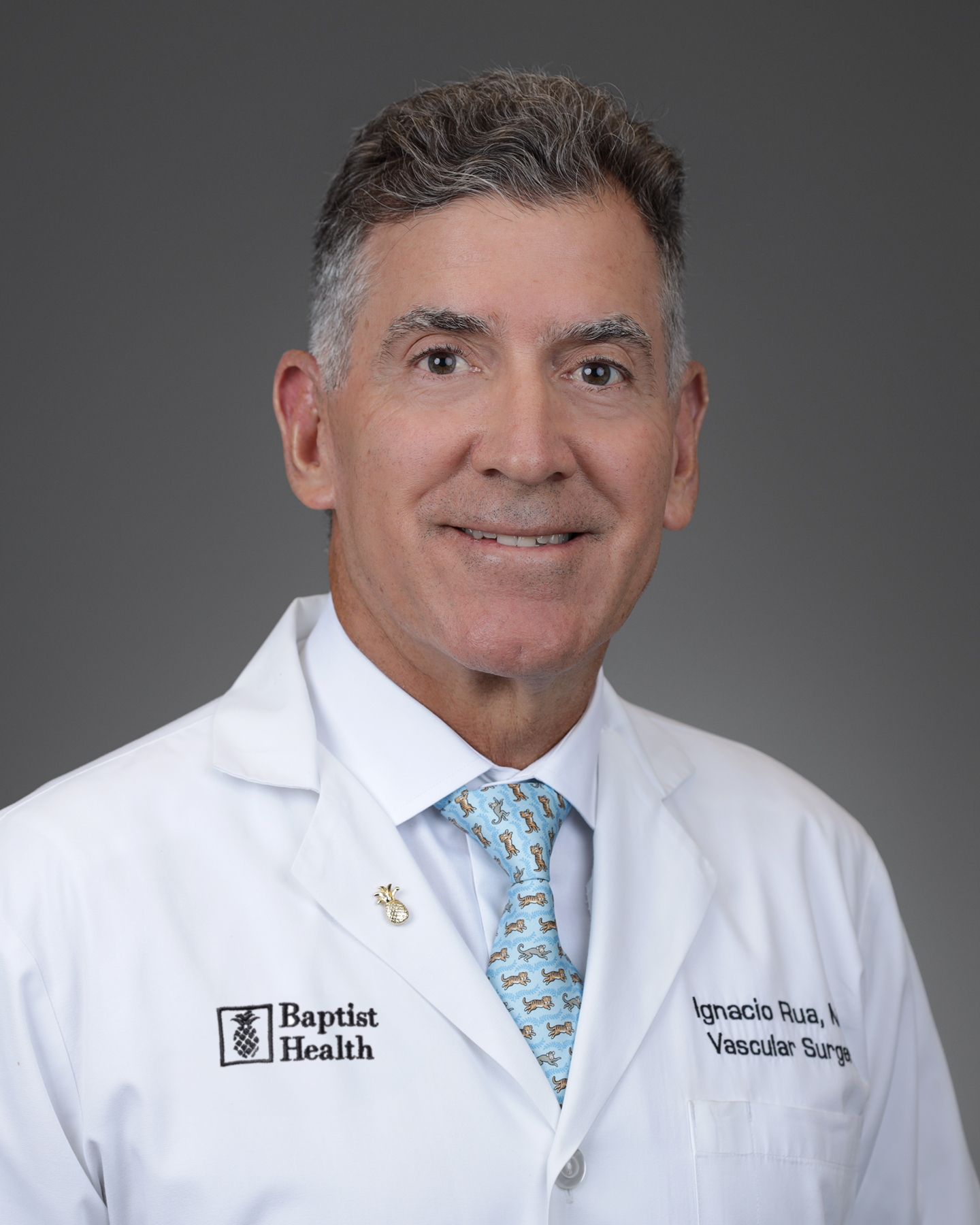
Ignacio Rua, M.D.
Current guidelines generally support intervention for ascending aortic aneurysms at 5 to 5.5 centimeters, depending on institutional expertise and patient-specific factors. However, connective tissue disorders, bicuspid valve disease, rapid growth, family history and aortic length may all justify earlier treatment.
“There’s still art and science to this,” says Ignacio Rua, M.D., vascular and endovascular surgeon at Baptist Health Miami Cardiac & Vascular Institute. “Every patient is different.”
Dr. CJ notes that risk assessment now extends beyond maximal diameter measurements.
“We’re looking at factors like aortic length, growth rate, family history, body size and systemic hypertension,” he says. “A patient with a 4.8-centimeter aneurysm and multiple high-risk features may warrant earlier intervention than someone with a larger but stable aneurysm.”
The physicians also emphasized that some dissections occur below traditional surgical thresholds, reinforcing the importance of surveillance and specialty evaluation.
“We’ve seen dissections at 3.8 centimeters. We’ve seen them at 4.2,” Dr. CJ says. “The guidelines provide a framework, but awareness, surveillance and individualized assessment matter tremendously.”
Why Early Referral Matters
Specialists say one of the biggest misconceptions among both patients and clinicians is that referral should occur only when surgery appears imminent.
Instead, early referral allows aortic teams to establish baseline imaging, identify high-risk features, optimize medical management and determine appropriate surveillance intervals before patients become unstable.
“For abdominal aneurysms, once patients reach around 3 to 3.5 centimeters, they should already be in surveillance,” says Brian Schiro, M.D., RPVI, FSIR, vascular and interventional radiologist at Baptist Health Miami Cardiac & Vascular Institute; program director of the FIU/Baptist Health Interventional Radiology Residency Program; and associate professor at Florida International University Herbert Wertheim College of Medicine. “Growth rate is extremely important. Rapid expansion may change management entirely.”
The panel repeatedly emphasized that outcomes are significantly better when patients undergo elective treatment rather than emergency intervention.
“If you have an acute aortic event, many patients never even make it to the hospital,” Dr. Taylor says. “But when we can intervene electively at the right time, mortality may be as low as 1 to 2 percent.”
The Expanding Role of Advanced Endovascular Therapies
Technological advances are also changing what is possible for patients previously considered too high-risk for intervention.
During the webinar, the Baptist Health Heart & Vascular team presented several complex cases involving hybrid repair, branched endografts and physician-modified devices used to preserve blood flow to visceral vessels while excluding aneurysms and dissections.
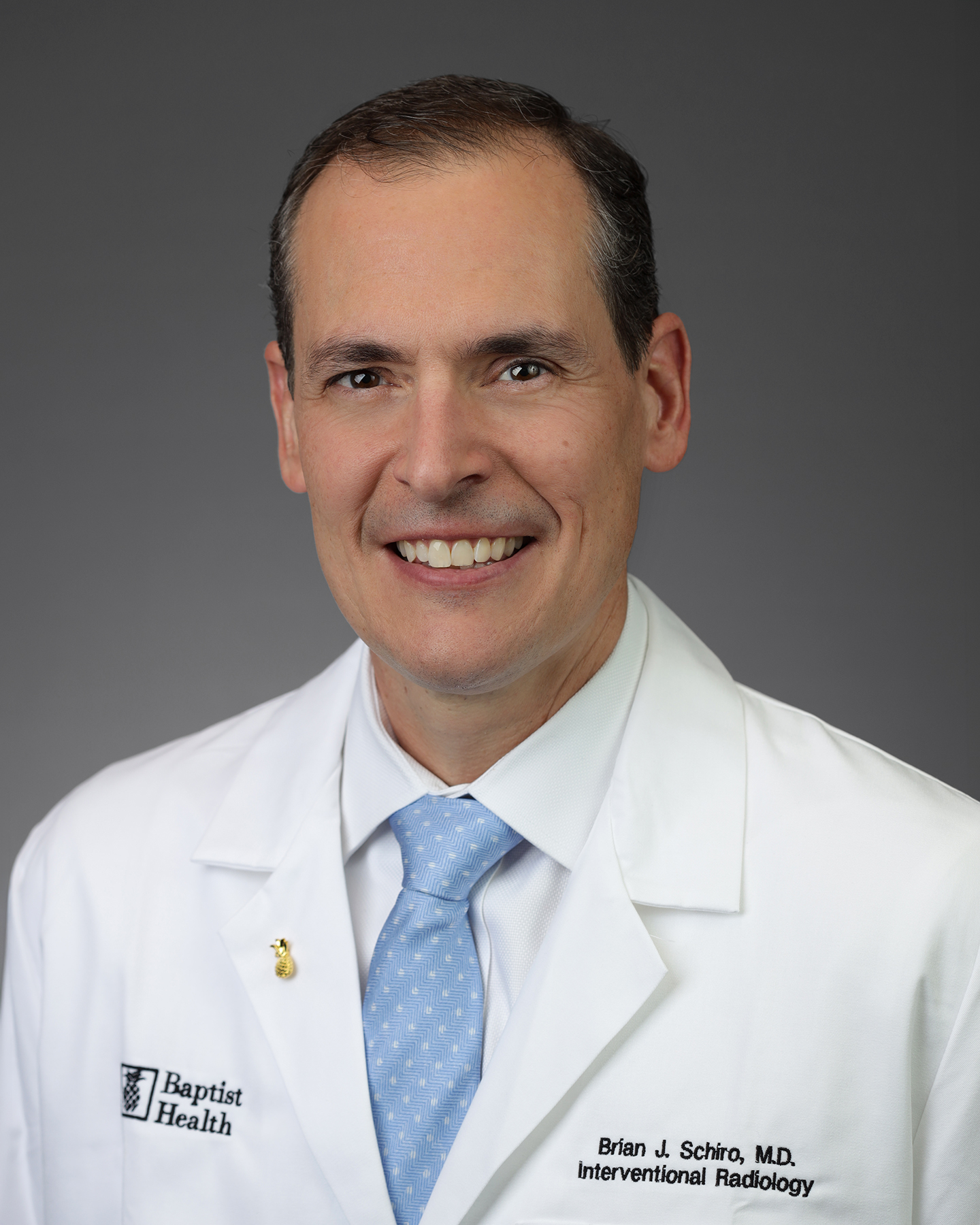
Brian Schiro, M.D., RPVI, FSIR
“These technologies are allowing us to treat patients who previously had very limited options,” Dr. Schiro says.
Many of these procedures rely on advanced imaging techniques, including high-resolution CT reconstruction, fusion imaging and intraoperative cone beam CT guidance to support precision planning and device deployment.
“The tools and image-guided therapies available today are remarkable,” Dr. Schiro says. “We’re fortunate to have the infrastructure and multidisciplinary expertise necessary to perform these procedures safely.”
The team noted that while endovascular approaches continue to evolve rapidly, patient selection and institutional experience remain critical.
“These procedures should be done at highly specialized aortic centers with the expertise and resources to manage complications if they occur,” Dr. CJ says.
Surveillance Remains Lifelong
Even after successful repair, physicians emphasized that patients with aortic disease require ongoing imaging and follow-up.
“Surveillance is absolutely critical,” Dr. Schiro says. “Even patients who’ve had open repair can develop recurrent aneurysmal disease later.”
The physicians also discussed the importance of cardiovascular risk reduction, including smoking cessation, blood pressure control and exercise modification.
“I still want my patients exercising,” Dr. Taylor says. “I want them active and maintaining cardiovascular health. What we discourage is the extreme straining and heavy Valsalva-type lifting.”
For clinicians, the message was clear: early recognition, surveillance and referral remain essential components of improving outcomes in aortic disease.
“The earlier we can identify these patients and bring together the right specialists, the better chance we have to intervene before catastrophe occurs,” Dr. CJ says. “That’s where multidisciplinary aortic care truly changes outcomes.”
