
Treating Pituitary Adenoma With Minimally Invasive Endoscopic Surgery

For Felix Taveras, 64, life is meant to be active. The Doral resident, originally from the Dominican Republic, works as an immigration consultant and enjoys helping people navigate their residency paperwork. Outside of work, he loves baseball, traveling, spending time with his two adult children and following baseball — especially the New York Yankees and Dominican Republic teams.
But an unusually severe headache eventually led Mr. Taveras to an unexpected diagnosis: a pituitary adenoma, a slow-growing, noncancerous tumor in the pituitary gland at the base of the brain. Such a tumor can seriously affect vision by compressing on the optic nerves. Those symptoms can include loss of peripheral vision on the left or right edges or general blurriness.
The discovery would lead him to seek a second opinion at Baptist Health Miami Neuroscience Institute — and ultimately undergo minimally invasive surgery with Evan D. Bander, M.D., neurosurgeon, director of endoscopic skull base surgery and co-director of the Pituitary Tumor Program at the Institute.
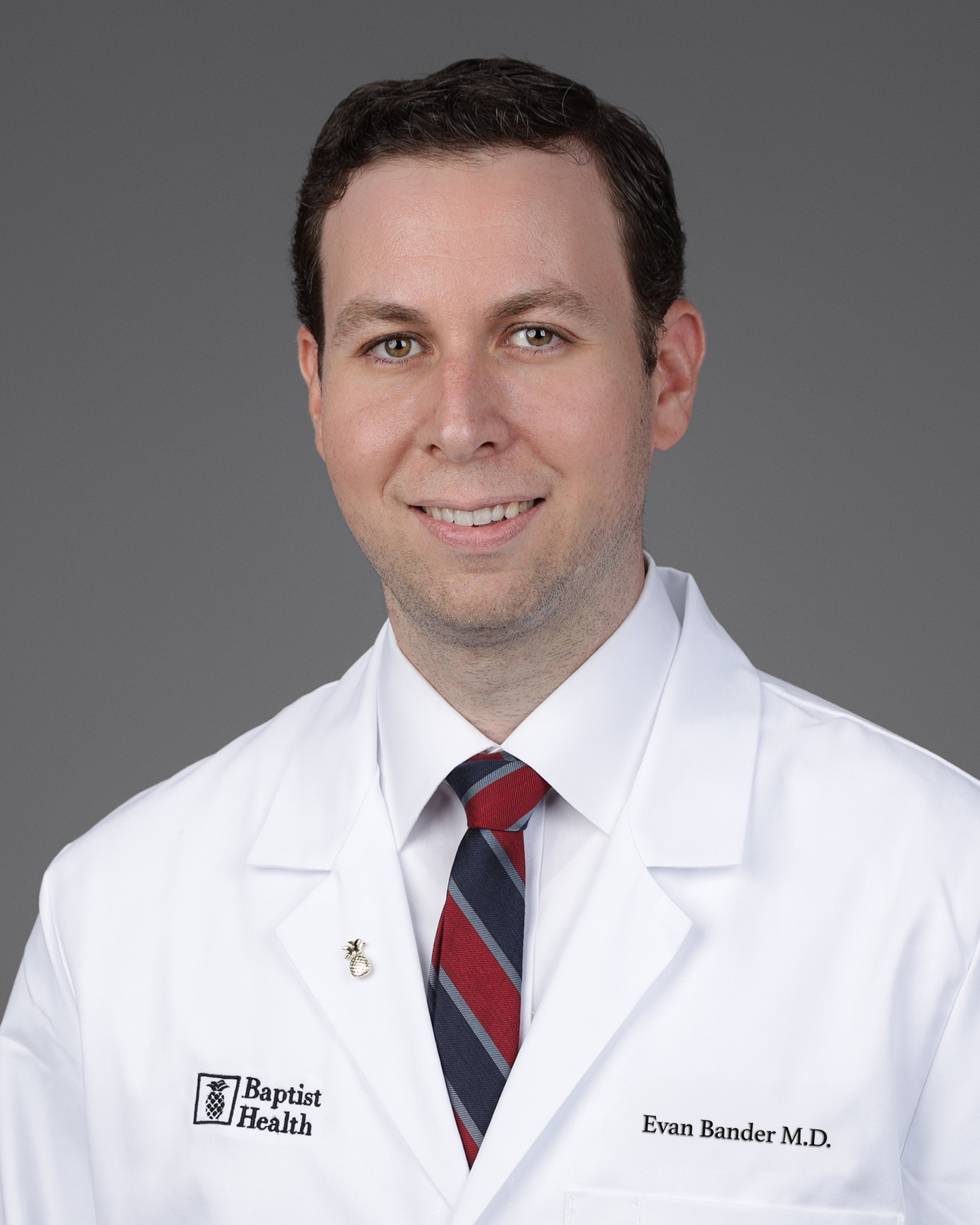
Evan D. Bander, M.D.
“When I first heard the diagnosis and saw the tumor, I was afraid,” Mr. Taveras recalls. “I had all these thoughts about my mother and my sister — they both passed away in August 2020 during COVID. It was very scary for me to go through brain surgery.”
Support from his family helped. So did his growing confidence in his medical team led by Dr. Bander.
Today, Mr. Taveras, who has a son and daughter in their 20s, is back to working, traveling and enjoying an active life.
A Headache That Couldn't Be Ignored
As Mr. Taveras recalls, he was visiting friends in New Jersey when he developed a headache and noticed that his blood pressure was elevated. His sister urged him to go to an emergency room, but because he was traveling, he decided to wait until he returned to Miami-Dade.
After getting home, however, he experienced an especially intense headache. “The headache was very strong,” he recalled. “That was probably the reason why I decided to go to the emergency room. My sister said, ‘If you have a headache like that, you have to go.’”
His daughter took him to an emergency department at another health system. Because Mr. Taveras was also dealing with a tooth infection and elevated blood pressure, those issues were initially addressed. Before leaving, however, he emphasized that he had experienced a severe headache the previous night.
That prompted a CT scan. The imaging revealed something unexpected in his brain. Additional evaluation showed that Mr. Taveras had a pituitary adenoma. He had never heard of the condition before.
“When they showed me the picture and I saw the big ball, I said, ‘Oh my God, this is serious,’” he said. “I didn’t care what it was. I knew I had to take care of it.”
Pituitary adenomas are benign tumors that develop in the pituitary gland at the base of the skull and are among the most common types of benign brain tumors, Dr. Bander explains.
Some are discovered incidentally during imaging performed for another reason. Others may be found during an evaluation for symptoms such as vision changes or headaches. Importantly, a headache that leads to imaging isn't necessarily caused by the tumor.
“Felix’s case is a good example of finding a mass that was not necessarily expected,” Dr. Bander says. “He did have severe headaches, but it may not have even been related to the pituitary tumor that he was found to have.”
Why a Second Opinion Mattered
The initial recommendation, at the outside hospital, was for Mr. Taveras to undergo surgery relatively quickly. For someone who had never faced a major operation like brain surgery, the prospect was difficult to process.
“The reason I wanted to get a second opinion was because they wanted me to go through surgery very fast,” Mr. Taveras explains. “I didn’t feel like I had an explanation of the options. This was going to be my first big surgery, and I was concerned.”
A friend helped connect him with Baptist Health Miami Neuroscience Institute, where he met Dr. Bander.
A second evaluation can be particularly valuable with pituitary tumors because determining the appropriate treatment involves much more than looking at an imaging scan. Pituitary adenomas can be functional, meaning they produce excess hormones, or nonfunctional. Specialists also need to assess whether a tumor is affecting surrounding structures.
“Pituitary adenomas really require a multidisciplinary team for appropriate management,” Dr. Bander said. “That team can include endocrinologists who help do the work-up for hormone evaluation, a neuro-ophthalmologist, a neurosurgeon and sometimes an ENT doctor.”
At Baptist Health Miami Neuroscience Institute, Mr. Taveras underwent additional evaluation, including testing of his vision.
Why Surgery Was Recommended
Not every pituitary adenoma needs to be removed. Smaller tumors may sometimes be monitored with surveillance imaging, while certain functional tumors can respond to medication.
Mr. Taveras’ tumor, however, was large and pressing against his optic nerves.
“In his case, what we found with the neuro-ophthalmology evaluation was signs of early atrophy of his optic nerves,” Dr. Bander says. “He didn’t have severe vision loss, thankfully, but we were able to pick that up.”
That finding helped make surgery the recommended treatment.
“His tumor, being quite large, was pushing on those optic nerves,” Dr. Bander explains. “In that case, we do often recommend surgery to remove that tumor and decompress the optic nerves.”
For Mr. Taveras, having the additional testing and an opportunity to understand his choices helped build trust in the treatment plan.
“When I spoke to Dr. Bander, I felt comfortable,” he said. “He explained to me that after doing all the tests, surgery was going to be the last option. He was going to look at the results first.”
A Minimally Invasive Approach to Brain Surgery
Even after deciding to proceed, Mr. Taveras remained understandably nervous.
“When I first heard the diagnosis and saw the tumor, I was afraid,” he said. “I had all these thoughts about my mother and my sister. It was very scary for me to go through brain surgery.”
Dr. Bander says explaining how the procedure works can help patients better understand what to expect. Pituitary tumors can often be removed through an endoscopic endonasal approach, which reaches the tumor through the nose —instead of requiring an incision in the head.
“While it is brain surgery, we don’t actually expose the brain in this endoscopic endonasal approach,” Dr. Bander says. “We go through the nose with an ENT surgeon, and we’re able to reach the pituitary gland without actually affecting any of the brain.”
Mr. Taveras also drew confidence from his family, faith and medical team.
When a lingering tooth infection raised concerns before surgery, the operation was postponed until the dental problem could be addressed.
“They did not rush into doing surgery,” he said. “They wanted to make sure that I was in shape when I came in. That was a good thing.”
Back to Work, Travel and an Active Life
Mr. Taveras underwent surgery in August 2025. Recovery required patience, particularly for someone accustomed to working, traveling and staying busy. His daughter helped care for him, and he gradually resumed his everyday activities.
“After the surgery, it took me around 60 days to go back to doing normal things like traveling and going back to work,” he said. “Now I’m back, I’m traveling, I’m working, and I’m so thankful for Dr. Bander and the team.”
His physician is equally pleased with the result.
“Felix, I think, had a great outcome and did extremely well from surgery,” Dr. Bander says. “He has gone back to his normal daily life, resumed all of his normal daily activities. He’s working, he’s exercising, and I think that’s always our goal for our patients after surgery.”
For people experiencing new or unexplained symptoms, both patient and physician emphasize the importance of seeking medical attention — and being comfortable with the team guiding treatment.
“Make sure you get checked, and always get a second opinion,” Mr. Taveras said. “Follow the directions of the doctors and the team, because that’s the most important thing in the recovery process.”
Dr. Bander agrees that patients should take the time they need to understand a diagnosis and their options. ““Make sure that you find the appropriate team, even if it means getting a second evaluation or going to additional physicians and spending a little extra time to make sure you’re comfortable — I think that’s really important.”
