
How FIU and Baptist Health are Using AI and Sound to Detect Heart Disease Earlier

Researchers at Florida International University (FIU), working in collaboration with Baptist Health South Florida, are combining a digital stethoscope with artificial intelligence (AI) and advanced sound analysis to better detect subtle signs of heart disease long before symptoms appear.
If successful, this innovation could transform how clinicians screen for cardiovascular conditions — making early detection faster, more accessible and potentially life-saving.
“The biggest way to save lives is to catch heart disease as early as possible,” said Tom Nguyen, M.D., FACS, FAC, chief medical executive of Baptist Health Heart & Vascular Care, director of Minimally Invasive Surgery, and Barry T. Katzen Endowed Chair at the Institute. “The idea behind this concept is that its technology can be portable and very small to hopefully be able to diagnose heart problems earlier and faster than the way we traditionally use it,” said Nguyen who serves as professor and chair of the department of cardiovascular sciences at FIU Herbert Wertheim College of Medicine.
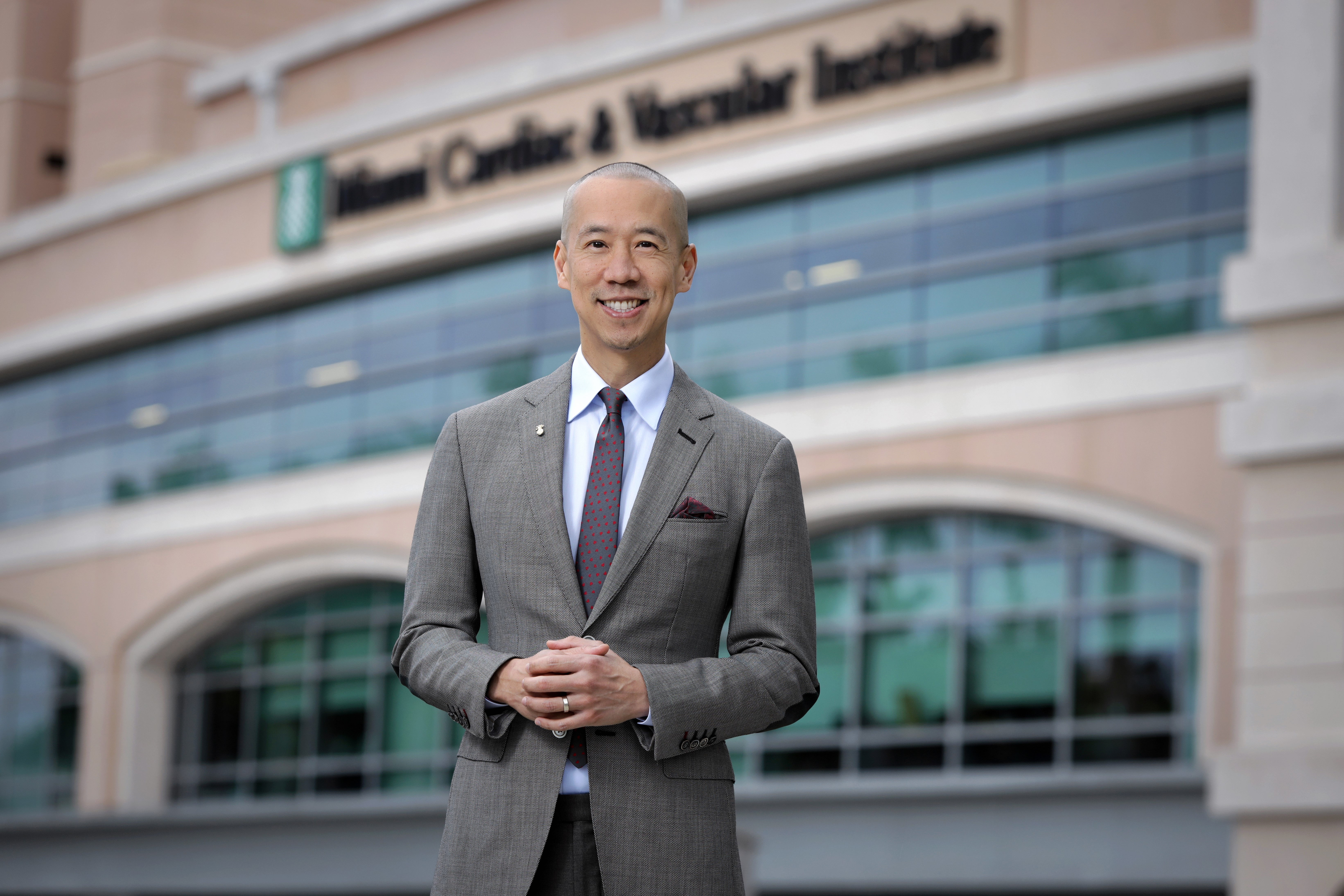
Tom Nguyen, M.D., FACS, FAC
Listening to the Heart in a New Way
For generations, the stethoscope has been one of the most recognizable tools in medicine. Physicians listen to the rhythm and tone of heartbeats to identify abnormalities. But even the most experienced clinicians are limited by what the human ear can perceive.
Researchers at FIU believe artificial intelligence can help unlock information hidden within those sounds.
“We've been working on developing an algorithm that can use heart sounds that are recorded digitally using a stethoscope,” said Valentina Dargam, Ph.D., research assistant professor of biomedical engineering at FIU. “Then we put these heart sounds into an algorithm that can detect whether you have early stages of heart disease.”
Using specialized digital stethoscopes, heart sounds are recorded and converted into data that can be analyzed by a machine-learning algorithm. The system searches for subtle acoustic patterns linked to early cardiovascular disease — patterns too faint or complex for human hearing alone to identify.
“Computers are really good at finding patterns and signals that we can't do with our own ears,” said Joshua Hutcheson, Ph.D., director of the FIU-Florida Heart Research Foundation Center for Innovation in Cardiovascular Health. “So we're leveraging that to develop algorithms that give us a precise indication of what's going on underneath.”
The early results are promising. In laboratory testing, the algorithm correctly identified healthy heart sounds with 95 percent accuracy and diseased heart sounds with 85 percent accuracy. Those findings suggest AI-powered listening tools could become a powerful supplement to traditional diagnostic methods.
But moving from promising research to real-world patient care requires something critical: clinical validation.
Bringing Research Into the Clinic
That next step is where Baptist Health South Florida plays a key role.
FIU researchers have partnered with Baptist Health to transition the technology from the laboratory into clinical testing. Through this collaboration, cardiovascular patients at Baptist Health who consent to participate will have their heart sounds recorded during routine cardiovascular evaluations.
Those recordings will be analyzed by the AI algorithm and incorporated into a growing database of real-world heart sounds.
This partnership allows FIU’s engineering and data science expertise to intersect with Baptist Health’s clinical leadership in cardiovascular care. Together, the institutions are working to create a large, high-quality dataset that will help the algorithm continue learning and improving.
Each recorded heartbeat helps the system better understand the difference between a healthy heart and one showing early signs of disease.
The goal is not to replace physicians, but to provide clinicians with an additional screening tool that can flag potential risks earlier in the diagnostic process.
Building a New Standard for Heart Screening
The collaboration between FIU and Baptist Health aims to turn this research into a practical clinical tool that could eventually become part of routine health screenings.
Researchers envision a future in which analyzing heart sounds with AI becomes as common as measuring blood pressure or taking a patient’s temperature.
“When you're getting your vitals taken, instead of having the medical doctor listen to your heart sound, a nurse records it, feeds it into the algorithm, and when you see the doctor, they're able to say: is this patient at risk? Do I need to do a further follow up?” Dr. Dargam said.
In this scenario, the digital recording process would take only seconds and could provide physicians with an additional layer of diagnostic insight before they even enter the exam room.
If the algorithm identifies patterns suggesting potential risk, physicians could then order additional tests such as echocardiograms or advanced imaging to investigate further.
Expanding Heart Monitoring Beyond the Doctor’s Office
Looking even further ahead, researchers believe the technology could eventually extend beyond clinical settings.
Future versions of the algorithm could potentially allow patients to monitor their heart health from home using connected digital stethoscopes or wearable devices. Such technology could help identify changes between doctor visits and alert patients to seek medical evaluation earlier.
While that vision is still several years away, the current collaboration between FIU and Baptist Health is an essential first step.
Over the next five years, researchers hope the technology will advance from research trials into routine clinical use across medical offices nationwide.
